News

Lab Members Selected to Present at ECVP 2025!

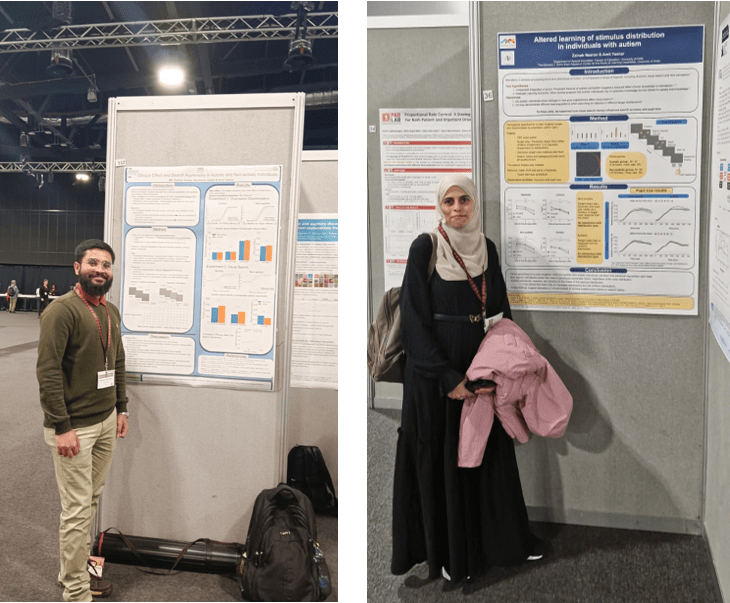
We are excited to announce that two of our doctoral students, Salman Sarkar and Zenab Saleh, have been accepted to present their research at the 47th European Conference on Visual Perception (ECVP), taking place in Mainz, Germany, from Sunday, August 24th to Thursday, August 28th, 2025.

🧠 Salman Sarkar

Talk Title: Competing Binocular Input During Development Disrupts Sensitivity to Environmental Regularities: Evidence from Congenital and Developmental Cataracts

Summary:
Salman’s research explored how early visual experience shapes the brain’s ability to learn from environmental regularities. Focusing on the “oblique effect” — the human tendency to perceive vertical and horizontal orientations more accurately than diagonal ones — his study examined individuals with various forms of visual deprivation due to cataracts. Strikingly, children who had cataracts in one eye later in childhood showed a reduced oblique effect, unlike those with bilateral deprivation from birth. These findings suggest that competing visual input may disrupt perceptual learning more than the absence of input, helping to define sensitive periods in visual development and highlighting the complexity of asymmetrical early experience.

👁️ Zenab Saleh

Talk Title: Mixture Modeling of Crowding Errors Reveals Reduced Peripheral Bias in Autism

Summary:
Zenab’s study on visual crowding in autistic and non-autistic adults analyzed how participants estimated the orientation and spatial frequency of Gabor patches in cluttered visual scenes, and found key differences in perceptual processing. While non-autistic individuals tended to rely more on outer (peripheral) distractors, autistic individuals showed a reduced peripheral bias, giving equal weight to inner and outer flankers. This suggests a fundamental difference in how visual information is processed in autism, particularly in complex, cluttered environments.


Laurina Fazioli Publishes First Authored Paper

We are thrilled to announce that PhD student Laurina Fazioli has published her first authored paper titled “Suboptimal but intact integration of Bayesian components during perceptual decision-making in autism” in the prestigious journal Molecular Autism (Fazioli, Hadad, Denison, & Yashar, 2025).

The Research

Laurina’s research focuses on visual perception and decision-making in autism spectrum disorder (ASD). Her current project, supervised by Dr. Amit Yashar and Dr. Bat Sheva Hadad, investigates how autistic individuals integrate prior knowledge and sensory information when making perceptual decisions. This framework, known as Bayesian perception, is a powerful tool for understanding how the brain combines different sources of information to arrive at a conclusion.

Key Findings

Laurina’s study employed psychophysical methods and computational modeling to examine how autistic and non-autistic individuals weigh sensory evidence and prior knowledge during perceptual tasks. The findings revealed that while autistic individuals showed suboptimal performance overall, their integration of these Bayesian components remained intact. These results challenge the notion that autistic individuals entirely lack the ability to integrate information probabilistically.

Applications

Laurina’s research helps to better understand perceptual decision-making in ASD. This knowledge can inform the development of targeted interventions to improve perceptual processing in individuals with ASD.

Congratulations Laurina!

Lab Awarded 5-Year Grant to Investigate Letter Recognition and Reading Developm-ent

Our lab is excited to announce that we have been awarded a prestigious 5-year grant from the Israel Science Foundation (ISF) to investigate the complex relationship between visual crowding and letter recognition. This is the lab’s second ISF grant, with the previous research studying visual attention and perceptual learning in visual crowding.

Why is this important?

Reading is a fundamental skill that relies on our ability to accurately recognize individual letters. However, visual crowding, a phenomenon where our perception of a target object is hindered by surrounding objects, can significantly impair this process.

What will we be researching?

We will explore how our brains’ ability to learn statistical regularities in the environment interacts with these processes.

Specifically: 

  • How our brains utilize both word-level (lexical) and letter-level (sub-lexical) information to recognize letters, especially outside the center of vision.
  • How visual crowding affects the reading abilities of young learners and its relationship to their overall reading proficiency.
  • Predicting future reading difficulties by identifying children who are particularly susceptible to visual crowding

Potential Impact

This research stands at the intersection of cognitive science and education. By understanding the mechanisms of letter recognition and visual processing, we aim to:

  • Develop more effective reading instruction methods
  • Create optimized visual displays that support learning
  • Provide early identification and intervention for children at risk of reading difficulties

Our work promises to illuminate the complex cognitive processes underlying reading, potentially transforming educational practices.

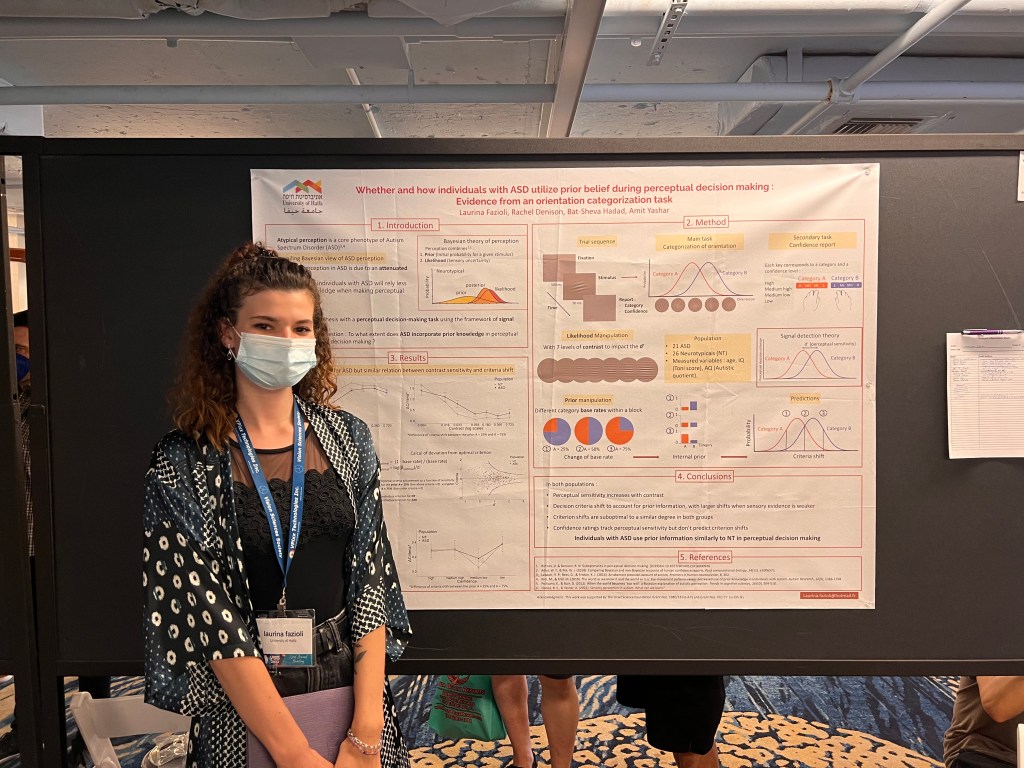
Laurina presented her study on perceptual decision-making in autism at the International Society for Autism Research (INSAR) conference(2023) and the Vision Science Society (VSS) conference(2023)

Laurina presented in a talk session at the International Society for Autism Research (INSAR) conference( 5.5.23 Stockholm, Sweden) and a poster at the Vision Science Society (VSS) conference (21.5.23 Saint Pete, USA) her Ph.D. project. In this project, Laurina shows that when making perceptual decisions on low-level stimuli, individuals diagnosed with Autism Spectrum Disorder integrate prior, likelihood, and reward information in the same suboptimal manner as individuals typically developed.Â